Dracula by Bram Stoker
What I said then:
The original, but is it the best?
What I say now:
Dracula, I'm sorry to report, is most definitely not the best. In fact, it's not even very good.
Jonathan Harker, a young real estate agent, travels from London to Romania to help settle the purchases of some land in England for a mysterious Transylvanian nobleman, Count Dracula. Once there, it slowly (too slowly) dawns on Harker that Dracula is creepy as fuck, that weird happenings are afoot, and that he, Harker, is now a prisoner in Dracula's ancient, crumbling castle. Once Dracula sets off for England, Harker's wife Mina and occult expert Abraham Van Helsing gather together a small group of monster hunters to counter his plans to take over the world, one innocent English neck at a time.
The book's got a heap of problems, but the main one is the simplest: there's not enough Dracula in it. The Count's eminent position in pop culture makes obvious that he's by far Stoker's most interesting/original/captivating creation. The novel's first section, involving Harker trapped in the Count's castle and slowly realising the horrifying truth about his host, is actually pretty good. Unfortunately, once the action moves to England, Dracula basically exits the book, never to return. From that point on we hear about his actions, but never really see them; we see how much other characters fear him, but never see anything that makes us fear him ourselves. It's a genuinely strange choice on Stoker's part.
In some respects he's hamstrung by his choice to make the novel epistolary(ish) --- that is, it's constructed entirely of letters, diaries and journal entries. Dracula isn't one of our correspondents, and as he spends most of the novel hiding from the characters whose point of view we're getting, we just don't see him. Still, there had to be a way to give us more blood-sucking action.
The other big issue Stoker has with his letters/diaries style is that almost every single character speaks in exactly the same tone of voice. Even Van Helsing, who has a few 'foreign' mannerisms to his speech, still speaks in basically the same manner, and with the same vocabulary, as everybody else. The other members of the anti-Drac league might as well be the same person, for all the personality that comes through their voices.
The other major issue I had with the book was the nature of the action: Stoker seems to have no idea how to structure his story to make the most of its inherent drama. The vast majority of the book is spent having theoretical discussions. When the anti-Drac league does take action, it's most often through waiting in doorways, or writing letters to shipping agents, or looking up train timetables. Even in the final denouement, which should be super-duper satisfying after we've waited so long for it, they kill Dracula without actually having to confront him! I mean, surely that's a no-brainer, right? I couldn't believe it.
Obviously the book is super famous and continues to be read widely, and it's not for no reason. And in some ways I can understand the appeal: not only would the text itself have been pretty daring for its time, but the subtext is absolutely, positively drenched in sex (or, more specifically, the fear of sex). I have no idea what Stoker had going on in his personal life, but I suspect he was pretty hung-up about a lot of things, because a hell of a lot of psychological weirdness seeps through the edges of the novel. Unfortunately, in my opinion he wasn't in control enough of that psychological stuff to make it focussed and thematically coherent, and he certainly wasn't able to marry it to a well structured story. This ended up a pretty major disappointment for me.
Cheers, JC.
Showing posts with label classical classics. Show all posts
May 15, 2013
February 20, 2013
Persuasion (#76)
Persuasion by Jane Austen
What I said then:
[One of] the last two unread books from my much-loved Folio Society boxset.
What I say now:
(Please note, that is NOT the cover on the edition I've got. I couldn't find an image of my version online, and this one was just too silly not to use.)
Persuasion was Jane Austen's final novel, and was written as her health went into its final, terminal decline. Lacking the energy to properly revise and edit her work, Austen left us a novel that is somewhat lacking in her usual masterful control (in terms of both plot and prose). In her finest works (massive Pride and Prejudice fan here), Austen's prose has that knack of being concise, witty, and true. But there are --- shock horror! --- inelegant sentences in Persuasion. There are plenty of elegant ones as well, but it was a bit of a shock to find myself having to read a sentence twice or thrice in order to grasp its meaning. That just doesn't happen with Austen, who ordinarily writes with perfect clarity.
In short: several years before the novel begins, Anne, the plain and oft-ignored (but supremely sensible and virtuous) third Elliot sister, was persuaded by her snobbish father to break off an engagement with Mr Wentworth, an impoverished naval officer. Since then the Elliot's fortunes have been frittered away, while Anne's sometime lover is about to return from the recently concluded wars a successful (and wealthy) man. Can their love survive her rejection of him, and the intervening years? Will she fall for her (way too obviously 'charming') cousin, William? There's also a plethora of subplots involving the romantic entanglements of Anne's silly, shallow cousins and sisters, and the machinations of their on/off flirtations with various gentlemen.
Though the scene in which Anne and Wentworth finally reconcile is quite wonderful and moving, and is the equal of anything in Austen's oeuvre, we've never really learned why we should hope for their reconciliation in the first place. Their love was formed and dashed before the novel ever begins, and we're never given much of an account of it. Then, for the vast majority of the book they act towards each other with cold formality, each wishing to bury the pain of the past. Austen relates this cold formality with considerable skill, but neglects to ever really delve into its inherent falseness, or to give us a glimpse of either characters' continuing love for the other. When the damn bursts, it feels less like a satisfying resolution to an ongoing story, than it feels like a bewildering bolt from the blue.
Several of the other, more minor subplots are resolved in similarly haphazard fashion. One of Anne's cousins, in the space of a couple of weeks in which we don't see her, falls out of love with one man and becomes engaged to another. This second suitor, given every single thing we've learnt about either character, should never have come to her notice at all (he's bookish and shy, she's wild and wilful). It's all a bit convenient.
Some of the subplots lead nowhere (and get resolved ridiculously easily), and there are dramatic events that are undeniably silly, and characters' interior lives seem to change in the blink of an eye to suit whatever purpose Austen requires. It's all a bit of a confused muddle. Don't get me wrong, there's still genius at play here, but it's only occasional, and you've got to look a little harder for it.
Cheers, JC.
currently reading: The Glass Bead Game by Herman Hesse
books to go: 72
What I said then:
[One of] the last two unread books from my much-loved Folio Society boxset.
What I say now:
(Please note, that is NOT the cover on the edition I've got. I couldn't find an image of my version online, and this one was just too silly not to use.)
Persuasion was Jane Austen's final novel, and was written as her health went into its final, terminal decline. Lacking the energy to properly revise and edit her work, Austen left us a novel that is somewhat lacking in her usual masterful control (in terms of both plot and prose). In her finest works (massive Pride and Prejudice fan here), Austen's prose has that knack of being concise, witty, and true. But there are --- shock horror! --- inelegant sentences in Persuasion. There are plenty of elegant ones as well, but it was a bit of a shock to find myself having to read a sentence twice or thrice in order to grasp its meaning. That just doesn't happen with Austen, who ordinarily writes with perfect clarity.
In short: several years before the novel begins, Anne, the plain and oft-ignored (but supremely sensible and virtuous) third Elliot sister, was persuaded by her snobbish father to break off an engagement with Mr Wentworth, an impoverished naval officer. Since then the Elliot's fortunes have been frittered away, while Anne's sometime lover is about to return from the recently concluded wars a successful (and wealthy) man. Can their love survive her rejection of him, and the intervening years? Will she fall for her (way too obviously 'charming') cousin, William? There's also a plethora of subplots involving the romantic entanglements of Anne's silly, shallow cousins and sisters, and the machinations of their on/off flirtations with various gentlemen.
Though the scene in which Anne and Wentworth finally reconcile is quite wonderful and moving, and is the equal of anything in Austen's oeuvre, we've never really learned why we should hope for their reconciliation in the first place. Their love was formed and dashed before the novel ever begins, and we're never given much of an account of it. Then, for the vast majority of the book they act towards each other with cold formality, each wishing to bury the pain of the past. Austen relates this cold formality with considerable skill, but neglects to ever really delve into its inherent falseness, or to give us a glimpse of either characters' continuing love for the other. When the damn bursts, it feels less like a satisfying resolution to an ongoing story, than it feels like a bewildering bolt from the blue.
Several of the other, more minor subplots are resolved in similarly haphazard fashion. One of Anne's cousins, in the space of a couple of weeks in which we don't see her, falls out of love with one man and becomes engaged to another. This second suitor, given every single thing we've learnt about either character, should never have come to her notice at all (he's bookish and shy, she's wild and wilful). It's all a bit convenient.
Some of the subplots lead nowhere (and get resolved ridiculously easily), and there are dramatic events that are undeniably silly, and characters' interior lives seem to change in the blink of an eye to suit whatever purpose Austen requires. It's all a bit of a confused muddle. Don't get me wrong, there's still genius at play here, but it's only occasional, and you've got to look a little harder for it.
Cheers, JC.
currently reading: The Glass Bead Game by Herman Hesse
books to go: 72
January 9, 2013
Les Miserables (#79)
Les Miserables by Victor Hugo
What I said then:
Not only is it 1,000 pages long, but it promises misery in its very title. Uh-oh.
What I say now:
By far the greatest thing this 'read everything I own' challenge has done for me is forcing me to sit down and give a chance to those classics which I would never have opened otherwise.
I was dreading Les Miserables. And then I read it, and holy hell, it was absolutely wonderful.
It's almost doing Victor Hugo and his masterpiece a disservice to call it a novel. As you finish it (you'll probably be crying), it feels like so much more than that. It's hard to get across the grandeur, the titanic majesty, the all-encompassing, all-consuming nature of this book and how it's written. If every other novel tells a story, then Les Miserables tells a whole world.
The only thing remotely comparable (in my reading, anyway) is Moby Dick, but where Melville brings an intense focus to a very narrow, limited time and place (the final voyage of the Pequod), Hugo is trying to do the same thing with something as large and ungainly as Paris, over the course of about twenty years. His ambition is so enormous that it's absurd; when he pulls it off, all you can be is flabbergasted.
Where can I even begin? Well, there's the huge cast of characters, all of whom feel vital and alive, despite also fitting neatly into one-dimensional archetypes. It's actually incredible how he does this, taking a stock character with one personality trait and making them seem so human, and so real. I couldn't even tell you how he does it, except to say that perhaps, by examining each of his cliches to such a microscopic level, he finds again the human truth that made it a cliche in the first place.
There's his magical turns of phrase. All of a sudden, in the middle of a long paragraph, there'll suddenly be a sentence that sums up an idea with such clarity and succinctness that it feels like an entirely new thought, minted fresh, that nobody's ever had before, yet which is obviously and utterly true.
And there's the way, across hundreds of pages, an uncountable myriad of plot threads slowly draw together, forming a vast tapestry that feels completely satisfactory. Nothing is left unexplained, no character's fate is left untold, yet it all hangs together as one single story. A momentous, epic, grand, beautiful story.
Now, look, there are undeniably things about Les Miserables which will challenge a modern audience. There's the way the same ten or so people keep bumping into each other, one fantastic coincidence following another. There's the way that Hugo, clearly a wannabe philosopher, treats his story like a clothesline, hanging on it all sorts of colourful digressions. (This actually becomes endearing, mainly because he's so good at it: he takes a timeout for fifty pages while he tells the story of the battle of Waterloo; he gives an exhaustive account of the criminal slang of the time; when his hero, Jean Valjean, enters a convent, he gives a history of the building, then a history of the order of nuns that has made it their home, then discusses that orders place within Catholic doctrine, then talks for a while about why he thinks religion is stupid. At the climax of the novel, at one of the moments of highest excitement, he spends twenty pages giving a history of Paris' sewers, and then ten more using them as an extended metaphor for the darkness in humanity's soul.) But if you are willing and able to forgive these eccentricities, you'll be in for one of the reads of your life. I promise.
Cheers, JC.
currently reading: The Lost Dog by Michelle de Kretser
books to go: 77
What I said then:
Not only is it 1,000 pages long, but it promises misery in its very title. Uh-oh.
What I say now:
By far the greatest thing this 'read everything I own' challenge has done for me is forcing me to sit down and give a chance to those classics which I would never have opened otherwise.
I was dreading Les Miserables. And then I read it, and holy hell, it was absolutely wonderful.
It's almost doing Victor Hugo and his masterpiece a disservice to call it a novel. As you finish it (you'll probably be crying), it feels like so much more than that. It's hard to get across the grandeur, the titanic majesty, the all-encompassing, all-consuming nature of this book and how it's written. If every other novel tells a story, then Les Miserables tells a whole world.
The only thing remotely comparable (in my reading, anyway) is Moby Dick, but where Melville brings an intense focus to a very narrow, limited time and place (the final voyage of the Pequod), Hugo is trying to do the same thing with something as large and ungainly as Paris, over the course of about twenty years. His ambition is so enormous that it's absurd; when he pulls it off, all you can be is flabbergasted.
Where can I even begin? Well, there's the huge cast of characters, all of whom feel vital and alive, despite also fitting neatly into one-dimensional archetypes. It's actually incredible how he does this, taking a stock character with one personality trait and making them seem so human, and so real. I couldn't even tell you how he does it, except to say that perhaps, by examining each of his cliches to such a microscopic level, he finds again the human truth that made it a cliche in the first place.
There's his magical turns of phrase. All of a sudden, in the middle of a long paragraph, there'll suddenly be a sentence that sums up an idea with such clarity and succinctness that it feels like an entirely new thought, minted fresh, that nobody's ever had before, yet which is obviously and utterly true.
And there's the way, across hundreds of pages, an uncountable myriad of plot threads slowly draw together, forming a vast tapestry that feels completely satisfactory. Nothing is left unexplained, no character's fate is left untold, yet it all hangs together as one single story. A momentous, epic, grand, beautiful story.
Now, look, there are undeniably things about Les Miserables which will challenge a modern audience. There's the way the same ten or so people keep bumping into each other, one fantastic coincidence following another. There's the way that Hugo, clearly a wannabe philosopher, treats his story like a clothesline, hanging on it all sorts of colourful digressions. (This actually becomes endearing, mainly because he's so good at it: he takes a timeout for fifty pages while he tells the story of the battle of Waterloo; he gives an exhaustive account of the criminal slang of the time; when his hero, Jean Valjean, enters a convent, he gives a history of the building, then a history of the order of nuns that has made it their home, then discusses that orders place within Catholic doctrine, then talks for a while about why he thinks religion is stupid. At the climax of the novel, at one of the moments of highest excitement, he spends twenty pages giving a history of Paris' sewers, and then ten more using them as an extended metaphor for the darkness in humanity's soul.) But if you are willing and able to forgive these eccentricities, you'll be in for one of the reads of your life. I promise.
Cheers, JC.
currently reading: The Lost Dog by Michelle de Kretser
books to go: 77
January 1, 2013
Crime and Punishment (#80b)
Crime and Punishment by Fyodor Dostoevsky
Why I bought it:
After getting over my fear of 19th century Russian authors with Anna Karenina, I thought I'd have another crack at one of the big ones. After doing some highly unscientific research (which mostly consisted of reading blurbs) I decided Dostoevsky was the most likely to be my cup of tea.
What I say now:
Crime and Punishment is a fascinating book. It manages to examine a tawdry, grubby little crime in such minute, exquisite detail that it actually becomes kind of beautiful, even transcendent.
Raskolnikov, a poor (and almost starving) student, manages in his addled state to philosophically justify committing a murder. After briefly (and ineffectually) planning it out, he goes ahead and kills an elderly pawn-shop owner. The actual murder scene is an incredible piece of writing, suspenseful and horror-filled to a degree that any contemporary crime writer would surely be envious of. It also takes place barely one-sixth of the way into the book: the bulk of the novel from then on is taken up by Raskolnikov's attempts to come to terms with what he's done (and continue to justify it in the face of sordid reality), and to stay ahead of the police.
Raskolnikov's wrestling with his conscience, which might in lesser hands be boring ('a man thinks' is hardly the stuff of great drama ... except when it's great, I guess) is given a kind of feverish, manic intensity by the thrill of Dostoevsky's prose. He also makes a genius decision in having Raskolnikov fall ill immediately after the crime: as the character's literal fever rages, his thoughts and feelings are clouded and confused in terms of real-life logic, but make perfect sense on a thematic and philosophical level.
Though it's founded on a moment of horrific violence, Raskolnikov's journey is strangely touching. A large part of his thinking before the murder, and even afterwards, is that, well, some men are great, and are destined for great things. The usual rules of society cannot apply to them. Raskolnikov fervently believes he has greatness inside of him, that he is capable of something magnificent. The murder becomes almost a test of this: if he is truly to lead a remarkable life, then he can't be caught, because that would interfere with his destiny. The realisation that comes late on --- that he is only an ordinary man, that there's no divine spark within --- is acually kind of heart-breaking. We've all had grand dreams, haven't we? And we've all had some moment when we've had to come to terms with the fact that we're not special, we're not incredible ... we're simply ordinary. It's not easy. But Dostoevsky's genius is to take the heartbreak of that realisation and make it beautiful: what could be better than to be a part of humanity? What could be worse than being unique, if being unique means being alone? Raskolnikov is not weakened by his epiphany, but strengthened. And, by reading this novel, so are we.
Oh, and a brief structural note: Crime and Punishment was written in the 1860's (at almost the exact same time as The Moonstone), which is right when modern police forces were just coming into being throughout Europe, and 'crime novels' were first being imagined. The major addition that Crime and Punishment gave to the incipient genre was Dostoevsky's brilliant use of small details in the crime scene, that could be recalled and expanded on later in the novel. By which I mean, there are several things mentioned in passing while the crime is being committed that come back later, either as clues or as important elements of mis-direction, as the police (and Raskolnikov himself) try to piece together what actually happened. This would become a staple of the genre (It's been ages since I read any Agatha Christie, but if memory serves this was a particular favourite trick of hers), but I seriously doubt if it's been done as well as Dostoevsky does it.
In summary, this book is incredible on every level: theme, plot and prose (major props to Richard Pevear and Larissa Volokhonsky, the translators of this edition). You really should read it.
Cheers, JC.
currently reading: The Brief Wondrous Life of Oscar Wao
books to go: 78
Why I bought it:
After getting over my fear of 19th century Russian authors with Anna Karenina, I thought I'd have another crack at one of the big ones. After doing some highly unscientific research (which mostly consisted of reading blurbs) I decided Dostoevsky was the most likely to be my cup of tea.
What I say now:
Crime and Punishment is a fascinating book. It manages to examine a tawdry, grubby little crime in such minute, exquisite detail that it actually becomes kind of beautiful, even transcendent.
Raskolnikov, a poor (and almost starving) student, manages in his addled state to philosophically justify committing a murder. After briefly (and ineffectually) planning it out, he goes ahead and kills an elderly pawn-shop owner. The actual murder scene is an incredible piece of writing, suspenseful and horror-filled to a degree that any contemporary crime writer would surely be envious of. It also takes place barely one-sixth of the way into the book: the bulk of the novel from then on is taken up by Raskolnikov's attempts to come to terms with what he's done (and continue to justify it in the face of sordid reality), and to stay ahead of the police.
Raskolnikov's wrestling with his conscience, which might in lesser hands be boring ('a man thinks' is hardly the stuff of great drama ... except when it's great, I guess) is given a kind of feverish, manic intensity by the thrill of Dostoevsky's prose. He also makes a genius decision in having Raskolnikov fall ill immediately after the crime: as the character's literal fever rages, his thoughts and feelings are clouded and confused in terms of real-life logic, but make perfect sense on a thematic and philosophical level.
Though it's founded on a moment of horrific violence, Raskolnikov's journey is strangely touching. A large part of his thinking before the murder, and even afterwards, is that, well, some men are great, and are destined for great things. The usual rules of society cannot apply to them. Raskolnikov fervently believes he has greatness inside of him, that he is capable of something magnificent. The murder becomes almost a test of this: if he is truly to lead a remarkable life, then he can't be caught, because that would interfere with his destiny. The realisation that comes late on --- that he is only an ordinary man, that there's no divine spark within --- is acually kind of heart-breaking. We've all had grand dreams, haven't we? And we've all had some moment when we've had to come to terms with the fact that we're not special, we're not incredible ... we're simply ordinary. It's not easy. But Dostoevsky's genius is to take the heartbreak of that realisation and make it beautiful: what could be better than to be a part of humanity? What could be worse than being unique, if being unique means being alone? Raskolnikov is not weakened by his epiphany, but strengthened. And, by reading this novel, so are we.
Oh, and a brief structural note: Crime and Punishment was written in the 1860's (at almost the exact same time as The Moonstone), which is right when modern police forces were just coming into being throughout Europe, and 'crime novels' were first being imagined. The major addition that Crime and Punishment gave to the incipient genre was Dostoevsky's brilliant use of small details in the crime scene, that could be recalled and expanded on later in the novel. By which I mean, there are several things mentioned in passing while the crime is being committed that come back later, either as clues or as important elements of mis-direction, as the police (and Raskolnikov himself) try to piece together what actually happened. This would become a staple of the genre (It's been ages since I read any Agatha Christie, but if memory serves this was a particular favourite trick of hers), but I seriously doubt if it's been done as well as Dostoevsky does it.
In summary, this book is incredible on every level: theme, plot and prose (major props to Richard Pevear and Larissa Volokhonsky, the translators of this edition). You really should read it.
Cheers, JC.
currently reading: The Brief Wondrous Life of Oscar Wao
books to go: 78
June 6, 2012
The Iliad (#85)
The Iliad by Homer
What I said then:
Well ... fuck. Maybe Proust isn’t as bad as it gets after all.
What I say now:
Oh my. So much snark. So undeserved. Seems like every time I sit down to read something I'm really dreading, it ends up surprising the hell out of me. The Iliad was no exception.
There’s a brief passage in Donna Tartt’s The Secret History (one of my favourite
novels) in which the characters discuss reading Dante. One of them has a
theory, that in order to read The Divine
Comedy, you have to be a Christian. “If one is to read Dante, and
understand him, one must become a Christian if only for a few hours … [it has]
to be approached on its own terms.”
I felt something similar about The Iliad: to read it properly I had to accept Homer’s morality as
my own, because you simply can’t read it using contemporary judgement. By our
standards, every man in the poem does vicious, horrible things. Slaughter is to
be gloried in, slavery is a given, rape will follow victory without any hint of
remorse. Hell, the possibility of remorse isn’t even countenanced. It’s an
alien time, and an alien way of thinking, and at the beginning of the poem I
had difficulty relating to that mindset. I’ll admit it, I was squeamish.
Helpfully, Homer describes his characters’ motivations
with wonderful clarity. What at first seem like strange, contradictory ideas
about duty, loyalty, glory, piety and honour, come to be perfectly
understandable, because they’re expressed with such ease and grace. It took a
while, but eventually I sort of learned to think like a Greek, and could accept
their alien morality within the confines of the poem. I suspect that clarity,
that ability to sum up a man’s thoughts in a moment, or with the application of
one perfect simile, is why the poem has endured. Homer can make ancient Greeks
of us all.
(For the purposes of this post, I’m talking about
Homer as if he was one man. This may not be the case. Because The Iliad and The Odyssey were part of an oral tradition for centuries before they
were ever written down, we’ll never know for certain the truth of how they were
originally composed. The translator of this edition, Stephen Mitchell, believes
there is a single original author, even going so far as to remove a section of
the poem that scholars believe was a later addition to the text. I must admit,
I’m kinda fascinated by what went on in that ‘lost chapter.’ I might have to
look it up in somebody else’s translation.)
As the war rages on the Trojan plains, Homer’s
narrative often flits up to Mount Olympus, where the Gods are watching, and
scheming. Basically every major plot point comes about because of the
intervention of one God or another. From swatting arrows and spears away from
their favourites, to raising rivers, the Gods play out their bickering
rivalries through the lives of men, the clash of armies. This leads to a kind
of heroic fatalism that is present in all the human characters. They know they
are merely agents of the Gods’ will and that they can’t change their destiny,
so instead they just accept it. Achilles knows he won’t survive the war, but
the knowledge doesn’t effect him in the slightest.
It’s also (in this translation, anyway) a total
page-turner. Writers like Tom Clancy or Matthew Reilly or whoever should check
it out, they might get some ideas. It’s incredibly violent, very gory (turns
out there’s a thousand ways to kill a guy with a spear, and Homer delights in
describing every single one in excruciating detail) and completely gripping.
Late in the poem there comes a moment when, after a few hundred pages of
squabbling and using humans as pawns, the gods actually come down from Olympus
en masse to join the fighting, on either side. It’s breathtaking, and kind of
terrifying (and I couldn’t help but think: ‘Why wasn’t this in that silly Brad Pitt movie? This is friggin’ awesome!’).
I’m noticing a really nice pattern with my reading: it
seems like every time I’m really dreading one of the books on my list, it
always turns out to be a pleasant surprised. And what do you know, The Iliad was exactly the same. I’d
probably never have picked this up if not for my reading challenge, but now I’m
incredibly glad I did.
Cheers, JC.
currently reading: Exquisite Corpse by Poppy Z. Brite
books to go: 84
June 2, 2012
Homer and Translation (and Cheating)
Before I start yakking away about The Iliad, I thought I'd take a moment to talk translation, and how important the translation is when reading an ancient work like this, and (not coincidentally) how I'm a total cheating arse.
The many different translations of Homer that abound in English mean that each new reader, if they bother to inform themselves, has a choice about what kind of Iliad they wish to read: the Richmond Lattimore translation is the most literal, taking as few liberties with the Greek as possible; the E.V. Rieu transforms poetry into prose; the Alexander Pope is apparently brilliant, but is more Pope's poem than Homer's; and so on, and on. How you respond to the work is obviously mostly to do with Homer, but in a situation where so many differing translations exist, your translator of choice will have an effect on your reading.
I own both The Iliad and The Odyssey, but both of them were books I picked up from the store for free (damaged Penguin books don't need to get sent back, so we get to take them if we want ... it's both a blessing and a curse, trust me), and I didn't pay any attention to whose translations I was shoving in my bag. I'd always intended, once the time came to read them, to do a bit of research, figure out which translations I wanted to read, and replace my copies if necessary. So, yes, I bought a book, which is technically cheating I suppose. But my copy of The Iliad turned out to be the first ever English translation, completed by George Chapman in around 1615. Reading a Shakespeare-era translation of a 3000 year old poem, which I'm already dreading reading anyway? Umm, no thanks.
I ended up going with Stephen Mitchell's recent translation, which seemed from the reviews to be doing its utmost to be accessible. A quick glance at page one confirmed my impressions.
Let's compare them. Here's the opening of the Chapman translation:
Achilles' baneful wrath - resound, O goddess - that impos'd
Infinite sorrows on the Greeks, and many brave souls loos'd
From breasts heroic; sent them far, to that invisible cave
That no light comforts; and their limbs to dogs and vultures gave:
To all which Jove's will gave effect; from whom first strife begun
Betwixt Atrides, king of men, and Thetis' godlike son.
And here's the same passage from Mitchell:
The rage of Achilles - sing it now, goddess, sing through me
the deadly rage that caused the Achaeans such grief
and hurled down to Hades the souls of so many fighters,
leaving their naked flesh to be eaten by dogs
and carrion birds, as the will of Zeus was accomplished.
Begin at the time when bitter words first divided
that king of men, Agamemnon, and godlike Achilles.
It's pretty remarkable that Chapman managed to fashion the entire Iliad (more than fifteen thousand lines of poetry) into rhyming couplets. But, being that this is the first toe I'm dipping into the waters of Classical Greek literature (okay, second toe: I was in a production of Lysistrata at school), I figured 'accessible' should be the quality that should carry the day. Having just finished, and adored, Stephen Mitchell's translation, I'm pretty sure I made the right choice. Now that my toe is thoroughly dipped, when the time comes for The Odyssey, I'll probably go with a translation that's a bit 'tougher'. I'm willing to let myself get there one toe at a time, though, know what I mean?
I'll have my proper review of The Iliad up in (hopefully) another day or two. In the meantime, here's the short version: it was great!
Cheers, JC.
currently reading: Exquisite Corpse by Poppy Z. Brite
books to go: 84
The many different translations of Homer that abound in English mean that each new reader, if they bother to inform themselves, has a choice about what kind of Iliad they wish to read: the Richmond Lattimore translation is the most literal, taking as few liberties with the Greek as possible; the E.V. Rieu transforms poetry into prose; the Alexander Pope is apparently brilliant, but is more Pope's poem than Homer's; and so on, and on. How you respond to the work is obviously mostly to do with Homer, but in a situation where so many differing translations exist, your translator of choice will have an effect on your reading.
I own both The Iliad and The Odyssey, but both of them were books I picked up from the store for free (damaged Penguin books don't need to get sent back, so we get to take them if we want ... it's both a blessing and a curse, trust me), and I didn't pay any attention to whose translations I was shoving in my bag. I'd always intended, once the time came to read them, to do a bit of research, figure out which translations I wanted to read, and replace my copies if necessary. So, yes, I bought a book, which is technically cheating I suppose. But my copy of The Iliad turned out to be the first ever English translation, completed by George Chapman in around 1615. Reading a Shakespeare-era translation of a 3000 year old poem, which I'm already dreading reading anyway? Umm, no thanks.
I ended up going with Stephen Mitchell's recent translation, which seemed from the reviews to be doing its utmost to be accessible. A quick glance at page one confirmed my impressions.
Let's compare them. Here's the opening of the Chapman translation:
Achilles' baneful wrath - resound, O goddess - that impos'd
Infinite sorrows on the Greeks, and many brave souls loos'd
From breasts heroic; sent them far, to that invisible cave
That no light comforts; and their limbs to dogs and vultures gave:
To all which Jove's will gave effect; from whom first strife begun
Betwixt Atrides, king of men, and Thetis' godlike son.
And here's the same passage from Mitchell:
The rage of Achilles - sing it now, goddess, sing through me
the deadly rage that caused the Achaeans such grief
and hurled down to Hades the souls of so many fighters,
leaving their naked flesh to be eaten by dogs
and carrion birds, as the will of Zeus was accomplished.
Begin at the time when bitter words first divided
that king of men, Agamemnon, and godlike Achilles.
It's pretty remarkable that Chapman managed to fashion the entire Iliad (more than fifteen thousand lines of poetry) into rhyming couplets. But, being that this is the first toe I'm dipping into the waters of Classical Greek literature (okay, second toe: I was in a production of Lysistrata at school), I figured 'accessible' should be the quality that should carry the day. Having just finished, and adored, Stephen Mitchell's translation, I'm pretty sure I made the right choice. Now that my toe is thoroughly dipped, when the time comes for The Odyssey, I'll probably go with a translation that's a bit 'tougher'. I'm willing to let myself get there one toe at a time, though, know what I mean?
I'll have my proper review of The Iliad up in (hopefully) another day or two. In the meantime, here's the short version: it was great!
Cheers, JC.
currently reading: Exquisite Corpse by Poppy Z. Brite
books to go: 84
April 25, 2012
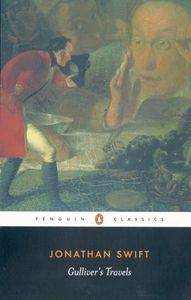
Gulliver's Travels (#87)
Gulliver's Travels by Jonathan Swift
What I said then:
He’s little! He’s big! It’s a satire! A Hollywood remake is on its way starring Jack Black! God help us all.
What I say now:
Anyway, to the book. I was slightly dismayed when I read the introduction and discovered this book was written in the early 18th century. Ignoramus that I am, I'd imagined it was Victorian-era, so to discover it was 150 years older than that made me a bit nervous. I don't think I've ever loved anything written before about 1820 (yep, Jane Austen, and I don't mind admitting it), so this was not a particularly pleasant discovery. However, Swift's writing soon put paid to my worries: there's nothing particularly difficult about his writing style. Indeed, considering Gulliver's Travels was written nearly 300 years ago, it's aged remarkably well. Succinct, clear and never overblown, the prose was perfectly accessible to a modern audience. Well ... it was to me, anyway.
A bigger issue, in the end, was the frustrating way this volume had been over-enthusiastically edited. By which I mean, there were a shitload of footnotes, most of which were simply defining the meanings of words that actually weren't all that obscure. Pretty much anybody with even a medium vocabulary, and anybody capable of inferring meaning from context, doesn't need explained to them that 'Zeal' means 'Passionate ardour for any person or cause', right? Or that 'Intelligence' can mean 'Information'. Come on, we've all seen spy movies, haven't we? Unfortunately, sometimes the targets of Swift's satire were completely specific to his time, so occasionally the footnotes were necessary to my understanding of the book ... so I couldn't just ignore them.
On the content of Gulliver's various travels, all I can really say is: there's a good reason why this book has lived on. Swift invents his different races --- the Lilliputians (they're small), the Brobdingnagians (they're big), and the Houyhnhnms (they're horses) --- with sophistication, wit, and wonderful attention to detail. Though it's Gulliver's travels in Lilliput and Brobdingnag that have the greatest hold on the popular consciousness, Swift saves his sharpest, most biting satire for the final chapter, Gulliver's stay with the Houyhnhnms. These horse-shaped beings are completely rational, and have organised their society in such a way as to make everybody within it perfectly content. By imagining a perfect society, then comparing it to his own, Swift tears everything about the human race to shreds. Our venality, our irrationality, our fears and mistakes and madnesses: Swift shows us just how foolish we puny humans are, by imagining a people free of all our faults. It's a wonderful (but also kind of horrible) piece of writing. Jonathan Swift was one mega-cynical guy.
As well as those three voyages, there's a fourth chapter which is less successful. Swift devotes this time to poking fun of 'natural philosophers' of his day, and their dubious experiments. After so much political satire, it seems an odd choice for a target, and given that those natural philosophers became the grandfathers of contemporary scientific thought, it doesn't really hit the mark. Still, nobody's perfect I guess.
All in all, Gulliver's Travels was a really enjoyable read. It holds a mirror up to the society of its time and doesn't like what it sees, and today we're enough like they were then to make the lessons Swift's teaching still valid. Perhaps even necessary.
(Before I sign off, let me apologise for the long delay between postings on here. To all four of my regular readers: sorry. Sometimes life gets in the way, you know? Basically, I've had two large writing projects bubbling away for several years now, and they both have kind of come to the boil at the same time. I've hinted cryptically about these 'large projects' in the past, but expect some biggish news soon. Oh look, I've gone and hinted cryptically again! Heehee ...)
Cheers, JC.
about to read: Dead Europe by Christos Tsiolkas
books to go: 86
September 7, 2011
The Moonstone (#98)
The Moonstone by Wilkie Collins
What I said then:
What I said then:
A classic Victorian novel ... but I hate Victorian novels. Most of them, anyway.
What I say now:
Yikes, I actually finished this nearly a week ago, but with the packing/moving/unpacking/"hey-where-did-I-put-that-really-important-thingy?" madness that's been going on in my life, I haven't had a chance to sit down and yarn about it. (I live in Port Melbourne now, in a rather lovely Edwardian terrace house, and my books have made the journey safely. I was tempted to 'lose' one or two of the things I'm most dreading having to read --- *cough* D.H. Lawrence *cough* --- but it would've felt too much like cheating.)
So: The Moonstone. No less an authority than T.S. Eliot described it as 'the first, the longest, and the best of all English detective novels' ... though, is a modernist poet really an authority on thrillers? In brief, a dying scoundrel bequeathes his niece, Miss Rachel Verinder, a ransacked Indian jewel on her eighteenth birthday, which goes missing that very night. Among the suspects are her two suitors, a reformed thief now working in the house as a servant, and three mysterious Indians who turned up in the town just as the stone did.
Collins tells the story in a succession of first-person narratives as several different people describe their relation to the jewel and the hunt for it, and the shifting points-of-view are probably the greatest strength of the book. Each narrator has a distinctive voice, which Collins nails, but even more than that, each has a distinctive take on the crime, on life, and on the other people involved. Facts us readers thought we could rely on are subsequently thrown into doubt, and the initial portrayals of certain characters are shown to be wildly inaccurate. The way Collins uses his multiple narrators to toy with our perceptions is brilliant sleight-of-hand, and has been much copied since (I'm sure it was done before Collins, too ... if you're better read than me and know by whom, leave me a note in the comments).
The case of the lost jewel is intriguing, but Collins goes one better by successfully linking the search for the truth about the theft with the search for the truth about Miss Verinder's love-life. The book ends up being as much about her attempts to find happiness as it is about any ginormous diamond, and is all the better for it. While being utterly central to the plot, she is not one of our narrators, so her actions --- both to do with the lost diamond and her two suitors --- are left unexplained until the last moments of the novel.
If there's one weakness, it's the ending. In order to fit everything together, Collins resorts to a device which, to a modern reader, comes across as slightly fantastical. After the rigorous realism of the first three quarters of the book, it felt like a let-down to me, and even a bit of a cheat. Which, seeings as this is a mystery novel, should probably kind of ruin it. I had so much fun up to that point though (the first narrator, a cantankerous old servant who's obsessed with Robinson Crusoe, is hilarious), that I'm willing to forgive.
Cheers, JC.
about to read: Drood by Dan Simmons (which is narrated by none other than a fictionalised Wilkie Collins. Coincidence? I think not!)
books to go: 97
August 20, 2011
The Three Musketeers (#99)
The Three Musketeers by Alexandre Dumas.
What I said then:
I have ridiculously fond memories of the early 90's Kiefer Sutherland/Charlie Sheen/Oliver Platt/Chris O'Donnell/Tim Curry film version. I doubt it was faithful though.
What I say now:
Okay, the plot is completely different, but in terms of the tone that colourful Disney film actually kinda nails it. It's bright and silly and fun (Oliver Platt as the venal braggart Porthos is a particular delight), just the same as the novel.
In a nutshell: D'Artagnan, a fiery Gascon, travels to Paris, where he meets and offends the titular Musketeers --- Athos, Porthos and Aramis --- and is challenged by them to three consecutive duels. Before the fighting can begin, some of Cardinal Richelieu's guards show up and try to arrest them: duelling is against the law. Forgetting their differences, the duellists turn on the guards and, victorious, become firm friends. Together they have several madcap adventures, most of them bound up with the competing political schemes of Richelieu and the Duke of Buckingham. They gain and lose money in bizarre ways, seemingly without a care. They pull their swords out at even the merest hint of an insult. And, memorably, they make an implacable enemy in Milady de Winter, a spy/assassin/stone-hearted-demon-bitch-from-hell who is in the Cardinal's employ.
There's not a massive amount to say about this one, because it's pretty much exactly what you'd expect. It's a chaotic riot of derring-do, dark plots, impossible escapes, and bloody demises. Buckles get swashed all over the place. Heck, one chapter even begins with the phrase "It was a dark and stormy night" ... oh, how the translator must have laughed when he got to that one! Hilariously, most of the characters' behaviour swings between the scrupulously lordly and the utterly insane: Buckingham, having fallen in love with the French Queen and been sent away to avoid a scandal, decides that England will wage an entire war on France just so he can see her face one more time ... and nobody bats an eye at his motivation.
The real highlight, though, is Milady de Winter. For most of the novel you think that Richelieu is the villain, but he at least has some sort of moral code to him. As the novel approaches its climax, though, it's Milady who becomes the main antagonist. A sociopath, pure and simple, her cold-blooded evil makes her one of the most entertaining characters you'll ever read. While D'Artagnan, Porthos and Aramis are all a bit one note, Milady and Athos, and their mysterious past, are by far the best thing about the book.
Not really knowing anything about Dumas at all before I read this, one point of interest for me was to learn that Three Musketeers is a historical novel: Dumas was writing more than 200 years after the time when his story is set. Not knowing any better, I'd always just figured he was a 17th century novelist writing about his contemporary times. In fact one of the main sources of humour comes from the prim 19th century narrator bemoaning the loose morals of the Musketeers' times, while simultaneously relating their adventures with near-indecent relish.
Seeing as it's exactly what you expect, if you think you'll enjoy The Three Musketeers, you probably will. I sure did.
(As an aside, just a few days ago I saw the trailer for the forthcoming mega-budget Three Musketeers 3D, and god it looks awful. If you want to make an effects-laden science fiction film, why would you choose Three Musketeers as your source material? It just makes no friggin' sense at all. Although, when I put that question to a friend of mine, his answer was "Because people have already heard of it," which is probably pretty close to the truth. 'Brand recognition' and all that. Ugh, Hollywood.)
Cheers, JC.
about to read: The Moonstone by Wilkie Collins
books to go: 98
What I said then:
I have ridiculously fond memories of the early 90's Kiefer Sutherland/Charlie Sheen/Oliver Platt/Chris O'Donnell/Tim Curry film version. I doubt it was faithful though.
What I say now:
Okay, the plot is completely different, but in terms of the tone that colourful Disney film actually kinda nails it. It's bright and silly and fun (Oliver Platt as the venal braggart Porthos is a particular delight), just the same as the novel.
In a nutshell: D'Artagnan, a fiery Gascon, travels to Paris, where he meets and offends the titular Musketeers --- Athos, Porthos and Aramis --- and is challenged by them to three consecutive duels. Before the fighting can begin, some of Cardinal Richelieu's guards show up and try to arrest them: duelling is against the law. Forgetting their differences, the duellists turn on the guards and, victorious, become firm friends. Together they have several madcap adventures, most of them bound up with the competing political schemes of Richelieu and the Duke of Buckingham. They gain and lose money in bizarre ways, seemingly without a care. They pull their swords out at even the merest hint of an insult. And, memorably, they make an implacable enemy in Milady de Winter, a spy/assassin/stone-hearted-demon-bitch-from-hell who is in the Cardinal's employ.
There's not a massive amount to say about this one, because it's pretty much exactly what you'd expect. It's a chaotic riot of derring-do, dark plots, impossible escapes, and bloody demises. Buckles get swashed all over the place. Heck, one chapter even begins with the phrase "It was a dark and stormy night" ... oh, how the translator must have laughed when he got to that one! Hilariously, most of the characters' behaviour swings between the scrupulously lordly and the utterly insane: Buckingham, having fallen in love with the French Queen and been sent away to avoid a scandal, decides that England will wage an entire war on France just so he can see her face one more time ... and nobody bats an eye at his motivation.
The real highlight, though, is Milady de Winter. For most of the novel you think that Richelieu is the villain, but he at least has some sort of moral code to him. As the novel approaches its climax, though, it's Milady who becomes the main antagonist. A sociopath, pure and simple, her cold-blooded evil makes her one of the most entertaining characters you'll ever read. While D'Artagnan, Porthos and Aramis are all a bit one note, Milady and Athos, and their mysterious past, are by far the best thing about the book.
Not really knowing anything about Dumas at all before I read this, one point of interest for me was to learn that Three Musketeers is a historical novel: Dumas was writing more than 200 years after the time when his story is set. Not knowing any better, I'd always just figured he was a 17th century novelist writing about his contemporary times. In fact one of the main sources of humour comes from the prim 19th century narrator bemoaning the loose morals of the Musketeers' times, while simultaneously relating their adventures with near-indecent relish.
Seeing as it's exactly what you expect, if you think you'll enjoy The Three Musketeers, you probably will. I sure did.
(As an aside, just a few days ago I saw the trailer for the forthcoming mega-budget Three Musketeers 3D, and god it looks awful. If you want to make an effects-laden science fiction film, why would you choose Three Musketeers as your source material? It just makes no friggin' sense at all. Although, when I put that question to a friend of mine, his answer was "Because people have already heard of it," which is probably pretty close to the truth. 'Brand recognition' and all that. Ugh, Hollywood.)
Cheers, JC.
about to read: The Moonstone by Wilkie Collins
books to go: 98
March 21, 2011
Anna Karenina (#111)
Anna Karenina by Leo Tolstoy
I’ve steered pretty clear of the weighty Russian masters, but I thought I should give at least one of them a go. Wish me luck.
What I said then:
What I say now:
When I was at Uni, I was briefly forced to study the short stories of Nikolai Gogol and Anton Chekhov, and I absolutely hated them. Ever since then I've had a major phobia about the 19th Century Russians. If I didn't like the short stories, what chance I'd dig the 800 page novels? It's probably unfair to tar them all --- Tolstoy, Dostoyevsky, etc. --- with the same brush, but hey, life ain't meant to be fair.
Nevertheless, I'm a pretentious enough jackass that when a damaged copy of Anna Karenina arrived at the store, I decided it'd look nice on my shelf and brought it home. Fast forward two years, add a dash of foolish-personal-challenge, and suddenly I was actually going to have to read it, something that I can truthfully say I would never have done otherwise.
And lo and behold, it was ... not terrible. I'd love to say that it was wonderful, and elements of it certainly were, but there was also a lot of fluff. Essentially, Anna is a beautiful, vivacious woman married to a much older, utterly loveless man. When she meets the handsome, charming Count Vronsky, she falls in love with him. Society is enjoyably scandalised, shit hits fans all over the place, teeth are gnashed and hearts broken. It's like a whole season of Days Of Our Aristocratic Russian Lives, without the eye-patched villains and insomnia victims.
At the same time, a second, (very) loosely related story involves an aristocrat farmer(!) named Levin trying to snare himself a wife and hopefully figure out the best way of living his life, and how to be happy within it.
My relationship to this book is an odd one: I feel like I should have hated it, because there was so much about it that annoyed me. Almost without exception, the characters are vacuous morons, and I despise the bloody lot of them. Things which have assumed enormous importance are dropped in an instant, when the character decides that it's not that important after all (Levin is a master of this). Very little ever even happens; for the most part, people mope about in sitting rooms having minor crises of the psyche. The whole thing kicks off with Anna and Vronsky having one of those 'locked-eyes-and-immediately-fell-for-each-other' moments that shits me in fiction because, frankly, I see it as the writer taking the easy way out (and it never happens in real life, does it?).
These are things that, given my preference for books with strong plots, should have had me raging.
But no, Tolstoy's writing is good enough that a character spending fifty pages pondering the state of Russian agriculture can be as gripping as any thriller. Okay, maybe not any thriller, but you get the point. Anna's disgrace, and the effect it has on her relationship with Vronsky, and how they try and fail to counter their increasing disillusionment, is recounted with a dispassionate, perfectly accurate eye. Levin's struggles for meaning in his closed little world, and his increasing desperation as he cannot find it, are, at times, incredibly moving.
Two sequences, one on either side of the story, stand out, both of them involving death: Levin and his wife nurse his brother as he passes away; Anna grows frantic at Vronsky's increasing coldness, and her disjointed, harried thoughts eventually lead her to a train station where (spoiler alert!) she throws herself under the 4.27 to Hurstbridge. In both passages, the thought processes the two characters undergo as they grapple with death, and with the fact that no-one living can ever understand it, are pieces of writing of immense beauty and skill.
Also, in places it's actually pretty funny. It's clear that Tolstoy himself is not a fan of the hoity-toity milieu in which most of the novel takes place, and there's a lovely snide tone to a lot of his writing. I can't get sarcasm into a text message, but he can get it across two languages and one hundred and forty years.
I didn't love Anna Karenina, I only loved elements of it. However, this novel has done me a great service: it's forever banished my fear of the Russians. I'm coming for you, Crime and Punishment!
Just not any time soon ...
Cheers, JC.
about to read: The Wise Man's Fear by Patrick Rothfuss (the big dumb epic fantasy sequel I threatened you with in my last post ... and a damaged copy showed up at work last week, so I didn't even have to buy it)
books to go: still 111
January 9, 2011
Jane Eyre (#116)
Jane Eyre by Charlotte Bronte
What I said then:
Because I should, I suppose. (side note --- sheesh, can you sense my reluctance?)
What I say now:
Fucking Jane Eyre.
Okay, before I start ripping into an acknowledged classic, I should at least own up to the fact that it was absolutely the wrong book at the wrong time. I doubt I'd have loved it no matter when I read it, but coming at the height of my Christmas-retail-insanity inspired snarkiness, I don't think I'm going to give it a very fair hearing. So please, take all these criticisms with a grain of salt, I'm almost certainly gonna bag it way more than it deserves.
So Jane, the titular character, is an orphan who's looked after by her mean aunt. Then she gets sent to a badly run school where her best friend dies. Then we skip ahead about eight years, and Jane leaves the school to become a governess, working for the mysterious, brooding Mr. Rochester. She falls in love with him. But (gasp!) Mr. Rochester has a dark secret that will keep them apart. Etcetera, etcetera. I bet you can't guess how it ends.
The novel is written in the first person, from Jane's point-of-view. Unfortunately, I found Jane to be a very dull character. She is, in her own quiet way, entirely good ... which is a fact that doesn't really lend itself to a dramatic narrative. While Jane has many obstacles placed in front of her, it's utterly predictable how she'll react to all of them, because she's entirely good. She has no inner turmoil, no personal demons to face, because she's entirely good. She's boring as hell, because she's entirely good.
Mr. Rochester, on the other hand, is kind of a prick. Sarcastic and mean, there's never any hint of a reason why Jane should fall in love with him (except for the fact that he's the only adult male she's ever had any prolonged contact with). Jane herself goes out of her way to inform us that he's ugly, ill-tempered, callous and cruel. So, to me, the entire 'romance' was without foundation, and therefore hopelessly compromised. I could feel nothing for either of them, because I couldn't see any reason why they'd feel anything for each other.
Huge chunks of the book have no bearing on the rest of the story. There's a very long sequence at the beginning with Jane as a young girl, first at her aunt's house and then at school. This takes up nearly a quarter of the book, yet has no real bearing on the movement of the narrative. In my edition, (spoilers ahead) Jane and Rochester attempt to be married for the first time on page 380. That could easily have been page 80, for all the import that the early scenes had on what followed.
Also, there's a 'mad' character. And I know Bronte was writing before the whole science of psychology even existed, but her treatment of insanity was unsympathetic and inane. It really annoyed the hell out of me.
And THEN, if all that wasn't enough to piss me off, about three-quarters of the way in to the novel, the whole story turns on a narrative coincidence so preposterous, so ridiculous, so unlikely, so ... well ... so fucking STUPID, that I consider it an unforgivable sin on the part of the writer. It was so dumb it actually made me laugh aloud. And if Jane Eyre hadn't lost me yet, it sure did then.
Ugh, I'm going to go read some sci-fi to get this stain out of my brain.
Yours in frustration, JC
about to read: The Diamond Age by Neal Stephenson
books to go: 115
Subscribe to:
Comments (Atom)