April 25, 2012

Gulliver's Travels (#87)

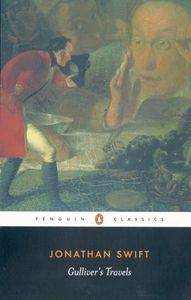
Gulliver's Travels by Jonathan Swift 


What I said then:

He’s little! He’s big! It’s a satire! A Hollywood remake is on its way starring Jack Black! God help us all.

What I say now: 

Haha, that Jack Black film sank without a trace, didn't it? Hell, even I didn't see it, and I see pretty much everything. That's how crap it looked.

Anyway, to the book. I was slightly dismayed when I read the introduction and discovered this book was written in the early 18th century. Ignoramus that I am, I'd imagined it was Victorian-era, so to discover it was 150 years older than that made me a bit nervous. I don't think I've ever loved anything written before about 1820 (yep, Jane Austen, and I don't mind admitting it), so this was not a particularly pleasant discovery. However, Swift's writing soon put paid to my worries: there's nothing particularly difficult about his writing style. Indeed, considering Gulliver's Travels was written nearly 300 years ago, it's aged remarkably well. Succinct, clear and never overblown, the prose was perfectly accessible to a modern audience. Well ... it was to me, anyway.

A bigger issue, in the end, was the frustrating way this volume had been over-enthusiastically edited. By which I mean, there were a shitload of footnotes, most of which were simply defining the meanings of words that actually weren't all that obscure. Pretty much anybody with even a medium vocabulary, and anybody capable of inferring meaning from context, doesn't need explained to them that 'Zeal' means 'Passionate ardour for any person or cause', right? Or that 'Intelligence' can mean 'Information'. Come on, we've all seen spy movies, haven't we? Unfortunately, sometimes the targets of Swift's satire were completely specific to his time, so occasionally the footnotes were necessary to my understanding of the book ... so I couldn't just ignore them.

On the content of Gulliver's various travels, all I can really say is: there's a good reason why this book has lived on. Swift invents his different races --- the Lilliputians (they're small), the Brobdingnagians (they're big), and the Houyhnhnms (they're horses) --- with sophistication, wit, and wonderful attention to detail. Though it's Gulliver's travels in Lilliput and Brobdingnag that have the greatest hold on the popular consciousness, Swift saves his sharpest, most biting satire for the final chapter, Gulliver's stay with the Houyhnhnms. These horse-shaped beings are completely rational, and have organised their society in such a way as to make everybody within it perfectly content. By imagining a perfect society, then comparing it to his own, Swift tears everything about the human race to shreds. Our venality, our irrationality, our fears and mistakes and madnesses: Swift shows us just how foolish we puny humans are, by imagining a people free of all our faults. It's a wonderful (but also kind of horrible) piece of writing. Jonathan Swift was one mega-cynical guy.

As well as those three voyages, there's a fourth chapter which is less successful. Swift devotes this time to poking fun of 'natural philosophers' of his day, and their dubious experiments. After so much political satire, it seems an odd choice for a target, and given that those natural philosophers became the grandfathers of contemporary scientific thought, it doesn't really hit the mark. Still, nobody's perfect I guess.

All in all, Gulliver's Travels was a really enjoyable read. It holds a mirror up to the society of its time and doesn't like what it sees, and today we're enough like they were then to make the lessons Swift's teaching still valid. Perhaps even necessary.

(Before I sign off, let me apologise for the long delay between postings on here. To all four of my regular readers: sorry. Sometimes life gets in the way, you know? Basically, I've had two large writing projects bubbling away for several years now, and they both have kind of come to the boil at the same time. I've hinted cryptically about these 'large projects' in the past, but expect some biggish news soon. Oh look, I've gone and hinted cryptically again! Heehee ...)

Cheers, JC.


about to read: Dead Europe by Christos Tsiolkas
books to go: 86

March 5, 2012

Aboriginal Stories of Australia, Aboriginal Fables and Legendary Tales, and Aboriginal Words of Australia (#90-#88)


Aboriginal Stories of Australia, Aboriginal Fables and Legendary Tales, and Aboriginal Words of Australia by A.W. Reed


What I said then:

They’re pretty much what they say on the tin, collections of Aboriginal dreamtime fables. I originally bought them as research for a long-delayed writing project.

What I say now:

Okay, I'm no expert at this sort of stuff, but the universality to the stories in these collections was pretty mind-blowing. By that I mean, if you replaced boomerangs and nulla-nullas with spears and swords, and swapped Wahn the mischievous crow for an evil witch, and changed the tribal elders to Kings and Queens, the vast majority of these dreamtime stories would be pretty much indistinguishable from a tale out of the Brothers Grimm. No matter who we are, or which corner of the globe our descendants wandered to back in the dawn of man, we all tell the exact same sorts of stories to try and explain the world around us.

That's pretty amazing to me. Aboriginal Australians arrived on this continent somewhere between 40,000 and 125,000 years ago, and never had contact with any outside influence until the late eighteenth century. And yet, despite that enormous gap when they were evolving separately, the stories they told around their camps were, in every narrative essential, exactly the same as the people of Europe (at this point I should admit my ignorance of the rest of the world's mythologies). It's not surprising that Joseph Campbell collated folktales from all over the world to create the idea of the 'monomyth' --- what's surprising is that it took someone so long to twig that we were all telling the same stories all along. If you ever needed more evidence that the very idea of racism is ridiculous, the universal nature of these stories would, I imagine, make anybody who reads them more aware of the fact that deep deep down, we are all the same. Heck, there's even one story, titled The Coming of Death, which is a nearly exact replica of the story of Adam and Eve.

(It's worth noting that these stories were all collected by white men, and it's impossible for a casual reader like me to know how much the narratives have been changed from their original form. It is certainly possible that the story's collectors and translators have adapted the tales to fit a more European narrative form, which could at least partially explain the universality I'm talking about. To get a definitive answer on that point would take a hell of a lot of time and research, but I feel it would be remiss of me to leave it unremarked. Reed's versions contain one element which points to this ambiguity: when specific geographical locations are mentioned, he uses their current names. It's hard not to realise that there's been editorialising by a white man when you're reading an ancient fable that's been given the title How the Murray River Was Made.)

One other fascinating element to these stories was the way that animals were once men, who had turned into animals as punishment for their misdeeds in a sort of reverse evolution. Many of them begin with the different animals in human form, then use the narrative to explain how each animal gained their unique characteristics. Why the kookaburra laughs in the morning, for example, or why koalas don't have tails, or where the galah got its unique plumage. Often devolving from human to animal is a punishment dished out by Baiame, the Great Spirit, or one of the other God-like beings that populate the sky. Often it's not actually possible until the end of a story to tell if it is about animals, or about dreamtime humans with animal names.

I probably shouldn't have include Aboriginal Words of Australia on my list of books to read in the first place. I'd thought it included essays and analysis of the language differences within the continent, but I was remembering wrong. It was actually just an alphabetical list of words, like a two-way dictionary, so obviously I didn't bother reading that. Apologies for the faulty memory (but I'm not too sorry, because hey, that's one more book down).

Anyway, reading these was a fascinating experience, and has me wanting to better explore and understand Aboriginal culture, as well as explore the oral histories and folk traditions of other regions of the world. And I should probably give Joseph Campbell a look as well, I guess.

Cheers, JC.


about to read: Gulliver's Travels by Jonathan Swift
books to go: 87

February 28, 2012

The Untouchable (#91b)

The Untouchable by John Banville


What I said a few days ago:

I saw Tinker Tailor Soldier Spy recently and thought it was a masterpiece, so I figured I'd continue with a 'repressed English spies' theme. Banville's novel is a fictionalised take on the Cambridge Five, and I've heard good things about it from several people.

What I say now:

Ooh, this one was a corker. In his dotage, Victor Maskell has been exposed as a Soviet spy and had his knighthood revoked. Repulsed by the journalists who camp out on his doorstep (and secretly glad that he can finally spill his secrets), he sets out to tell his own story, beginning a journal. As his reminiscences wander up and down the paths of his covert, secretive life, he comes to finally understand just what part he's been playing, and what he has sacrificed himself for.

Banville's Maskell is a wonderful character, and the perfect narrator for a spy story, for he's a man who lives every facet of his life in a sort of permanent state of duality. He is an Irishman, but grows up Protestant and loyal to the English. He is gay, but married with two children (his wife is the sister of his secret, life-long love). He is a welcome guest at Buckingham Palace, referring to the royal family with touching familiarity, yet he is a Russian spy. He is a brilliant judge of character, but is wilfully blind to so much of what is happening around him. It's that duality, that ingrained rootlessness, that Banville, Irish himself, is so fascinated by. Maskell contorts himself to suit every available ideology, like he's playing the world's hardest game of Twister, and ends up falling on his arse.

Like the narrator of Margaret Atwood's brilliant Cat's Eye, Maskell comes to understand his own story through the act of telling it, piecing together the extent (and the author) of his betrayal only in the novel's final moments. I love that use of a first person narrator, where the author only allows the narrator to piece things together after the audience already has. It's a tightrope, but Banville walks it with aplomb.

Similar in tone to Tinker Tailor, calling The Untouchable a spy story might give you the wrong idea. There are no chases and no 'action' scenes. There is one gun, but it is never fired. If you're thinking Jason Bourne, you've got it wrong. Maskell is simply a pawn, delivering low-level information, never approaching the heart of great intrigues, always a minor player. The novel is about one man's soul, not international politics.

The prose is a bit overbearing, but Maskell is a pompous ass, wielding his impressive vocabulary like a cudgel (this novel had me reaching for a dictionary more than any I've read in years), so the wafty, overly literary style suits him perfectly. Maskell, the character, is a celebrated art historian, and was at Cambridge in the thirties ... how else would he write?

Oh, and speaking of, the brief portrait we get of the heady University days of these characters is absolutely brilliant. Young, insouciant, believing (rightly) that the fate of the world was in their quick, clever hands, it's hard not to fall in love with this troop of merry Marxists, even as they make horrible mistake after horrible mistake. I didn't love Brideshead Revisited when I read it, perhaps because, written too close to those times, it couldn't quite gather the courage to bluntly nail its characters to the wall the way Banville does. With the space of sixty-odd years behind him, Banville's portrait seemed more honest (and was way more fun).

Occasionally a bit of a slog, but nevertheless highly recommended.

Cheers, JC. 


about to read: Aboriginal Fables and Legendary Tales, Aboriginal Stories of Australia and Aboriginal Words of Australia by A.W. Reed
books to go: 90

February 27, 2012

The 2012 Oscars (part two)

Aah, the glorious march of predictability.

The Artist took out its big three: Best Picture, Best Director for Michel Hazanivicius (bless you!), and Best Actor for (the villainously versatile) Jean Dujardin. It also added Score (despite ripping off the score from Vertigo) and Costume Design, which had it tie with Hugo on five statuettes apiece.

My call on Hugo kicking technical arse was vindicated in a big way. Cinematography, Art Direction, Visual Effects (the dudes from Rise of the Planet of the Apes were robbed), and the two sound categories which nobody really cares about made up its five.

In the screenplay categories, my Hopes were dashed by my Predictions: neither Midnight in Paris or The Descendants was well-structured enough for me to be overjoyed by their wins. Lovely, both of them, but not much more than that.

Meryl Streep overcame her 29 year long case of the yips to win, and you could tell she'd been planning that speech a while, it was self-effacing, funny and gracious. Everybody should have a dozen near-misses to let them prepare.

And on the topic of long waits, Christopher Plummer was just as charming picking up his gong for the severely underrated Beginners. I'm glad he took the trouble to give such an extended shout-out to Ewan McGregor, who was wrongfully ignored for his half of their scenes.

While I could understand Plummer's standing ovation (he's eighty-two, the oldest actor ever to win), less understandable was the ovation doled out to Octavia Spencer when she won for The Help. Okay, call me a cynical bastard, but were they standing up just because she's African-American? Or is there a behind the scenes story that I'm not aware of?

Australia's own Kirk Baxter winning for Editing for The Girl with the Dragon Tattoo was about as surprising as the show got, and also led to the night's best line from his editing partner Angus Wall. Having been genuinely shocked, they'd run out of things to say, but the 'bugger off' music hadn't even started. Just when things were getting a mite awkward, Ward said simply: 'We're editors. Thank you.' And they scampered off. Gold.

Funniest line? Yes. The night's funniest moment, though, came from Jim Rash, one of the winners for adapted screenplay. After Angelina Jolie came out and shamelessly flaunted her knockout pins by taking an unusual stance that made use of her high-slit gown but looked frankly bizarre, Rash upstaged Alexander Payne's speech by copying her in the background. Gold times ten.

Oh, and a member of Flight of the Conchords has now won an Oscar. Gold times a hundred.

Anyway, that's that for another year. Of course I loved every second of it. Before I go I'd like to thank blogspot, God, my parents, and James Earl Jones. Thank you so much.

Cheers, JC.


currently reading: The Untouchable by John Banville
books to go: 91

The 2012 Oscars (part one)

So, I made sure I had today off work months ago, and not because I'm a political junkie who had miraculously divined that the Labor Party would meltdown this morning. Nope, I took today off because I am an Oscars Nerd. For some reason nothing gets me tingling quite like a boring awards ceremony does --- if there's ever a year that a Melbourne player might actually win it, I'll probably even blog about the Brownlow. And let's face it: the Oscars shit all over Brownlow night, mainly because movie stars are way prettier than footy players.

Anyway, on to my predictions:

BEST PICTURE: Unfortunately, The Artist has this one all wrapped up. It would be a major shock if anything else wins, which sucks, because The Artist just wasn't that good. It took a cute idea for a sketch and made a whimsical, fluffy little film out of it. If people still give two shits about this feather-light movie in five years, I'll eat my horse. Scanning the other nominees, though, makes for depressing reading: Oscar voters have fucked up big time this year. While I know that The Descendants, Hugo and Midnight in Paris all have their champions, they're all deeply flawed (and in Paris' case, deeply unambitious) movies, which wouldn't have a prayer in a stronger year. I guess karma's coming round for the pretty kick-arse list they served up last year, but still. I'll be rooting for The Tree of Life here, and for best director (even though it doesn't have a chance in hell at either of them) because it's the only nominated film that's really aiming for greatness. Everything else is safe, and ultimately mediocre.

And seriously, War Horse? What. The. Fuck.

BEST DIRECTOR: The French dude will win, which will be nice because we'll all learn how to pronounce his name. "Hazanivicius." "Umm ... gesundheit?" It'd be nice if Terence Malick got the equivalent of a lifetime achievement award in this category, but he's probably the biggest outsider. And sure, Woody Allen, Martin Scorsese and Alexander Payne deserve accolades ... just not for these movies.

BEST ACTOR: And the other French dude will win this one, just to shove it up me for not liking that fucking movie (Question: doesn't America hate France? Anybody else remember Freedom Fries? What happened to all that?). I'd love love love for Gary Oldman to win for Tinker Tailor Soldier Spy, for the foolish reason that I thought his performance was flat out amazing. Unfortunately it was also mostly internalised, so he's going to lose to an over-the-top pratfalling buffoon. Okay, that's a bit harsh: Jean Dujardin was very good at what he was asked to do. It's just, what he was asked to do wasn't really all that special. Oldman's task was infinitely harder, and he rose to it in spectacular fashion. Pitt and Clooney, meanwhile, seemed to get their nominations more based on who they are than on what they did. They were fine in Moneyball and The Descendants respectively, but I don't know if they were much better than fine.

The biggest nominations shock across all the categories was easily Demian Bichir getting a Best Actor nod for A Better Life. Until the nominees were announced I'd never even heard of that movie, and I'm all over this shit like that gross rash on my back. It hasn't been released here in Australia yet, so I can't bitch about it yet. But when something scores a nomination coming from this far back, it usually means that it's actually pretty darn good (see also: A Separation's nomination for original screenplay) so I'll make sure to check it out when it does arrive down under.

BEST ACTRESS: Aah, a category that isn't completely cut and dried. God, what a relief. While for a big chunk of this awards season has seemed like a coronation march for Meryl Streep's take on Margaret Thatcher in The Iron Lady, there's been some recent whispering that she's losing ground. Maybe Hollywood on the whole just wants to keep her remarkable 'getting nominated then losing' streak going (17 nominations, 2 wins), because she's so good at making that gracious loser face. If they do deny Streep, they'll give it either to Michelle Williams for her Marilyn Monroe in My Week With Marilyn, or Viola Davis for giving a bit of soul to The Help. Any of those three actresses would make worthy winners (they were all by far the best thing about their respective films), but if forced to choose I'd probably go with Williams (and not just because of my prediction this time last year). As much as I admire Williams' work, Marilyn Monroe was one of the greatest comic actresses there's ever been, and I didn't think she'd be able to nail the magical 'on-camera' Marilyn. I was happy to be proven wrong.

Elsewhere, Christopher Plummer and Octavia Spencer seem to be locks for the Supporting Actor/tress awards, and the screenplay statuettes could go anywhere (my hopes: Original to A Separation, Adapted to Tinker Tailor. My predictions: Original to Midnight in Paris, Adapted to The Descendants). Hugo has so many nominations that it's got to win something, but it'll probably be limited to more tech-ish stuff, with it and Tree of Life duking it out for the cinematography award.

The main controversies this year are: no Michael Fassbender nomination for Shame? For shame. And the year the Muppets are nominated for best song, they decide they won't have performances of the songs in the ceremony. Let me repeat that: they could have had the Muppets singing at the Oscars, and they decided not to. I don't know who's making these decisions, but they need to be shot and killed. And then set on fire, just for good measure.

Anyway, I'll be back in a few hours to dissect how it all played out. 'Til then, sit back, have some Freedom Fries, and enjoy watching a whole bunch of wealthy, beautiful people sucking each other's dicks. I know I will.

Cheers, JC.


currently reading: The Untouchable by John Banville
books to go: 91